
When you purchase through links on our site, we may earn an affiliate commission. How it works.
Quick Answer
- Compounds: Rest 2.5 to 4 minutes on heavy squats, deadlifts, and presses to maximize ATP resynthesis and maintain maximum mechanical tension.
- Isolations: Cap accessory movements (curls, lateral raises, triceps extensions) at 60 to 90 seconds to preserve training density and metabolic stress.
- The Hard Limit: Resting past 5 minutes without a specific max-effort powerlifting mandate cools down connective tissue, spikes injury risk, and turns a 60-minute workout into a wasted afternoon.
You can absolutely rest too much between sets. Walk into any gym, and you’ll see it. Lifters take a set of squats three reps shy of failure, then sit on a bench doomscrolling for six minutes. That’s not strategic recovery. That’s just wasting damn time.
On the flip side, the old-school bro-science pushing a 30-second stopwatch on heavy compounds is just as broken. Cutting rest periods too short on compounds guts your performance. It forces you to strip weight off the bar. It robs your motor units of high-threshold recruitment.
Exercise science makes the trade-off clear. Recovery between sets replenishes cellular energy systems. It clears acute peripheral fatigue. It allows you to attack the next set with maximal force. Once that physiological threshold is met, sitting around yields zero extra hypertrophy. It actively works against workout density and soft-tissue readiness. In our experience, lifters who control their rest intervals progress far faster than those who leave recovery to guesswork.
Why Does Rest Interval Duration Matter for Muscle Growth?
Muscular hypertrophy and raw strength gains are driven by mechanical tension. To generate high mechanical tension, your fast-twitch motor units must produce force against substantial resistance, repeatedly. That process demands adenosine triphosphate (ATP). ATP depletes rapidly within 10 to 15 seconds of heavy lifting.
Your body recharges ATP via the phosphagen (ATP-PCr) system. Published data shows about 85% to 90% of your phosphocreatine stores refill within 2 to 3 minutes of rest. By minute 4, you’re near 95% recovery. Waiting 7 or 8 minutes offers diminishing returns. You don’t gain a sudden surge of extra strength. But your nervous system arousal drifts. Your elevated muscle temperature drops.
0:30 Rest —> ~50% ATP-PCr Refill —> Severe load drop, high metabolic fatigue 1:30 Rest —> ~75% ATP-PCr Refill —> Moderate performance, ideal for small isolations 3:00 Rest —> ~90-95% ATP-PCr Refill —> Optimal mechanical tension for compound lifts 5:00+ Rest —> ~98% ATP-PCr Refill —> Diminishing returns, loss of tissue heat
When you cut rest too short on multi-joint lifts, systemic cardiovascular fatigue or localized acidity becomes the limiter, not target muscle recruitment. When you rest excessively long, workout density collapses. Total training volume per hour plummets. Your joints cool down. Calibrating rest finds the sweet spot. It keeps performance peak without dragging the session into a marathon.
Can You Rest Too Much Between Sets During Heavy Training?
Related reading: 4-Day Upper Lower Split: The Complete Workout Plan for Strength & Size
The short answer is yes. Can you rest too much? Absolutely. The threshold depends on the movement profile, the neural demand, and your target adaptation.
When rest extends beyond five minutes on standard hypertrophy work, three distinct problems emerge:
- Loss of Muscle and Tendon Temperature: Elevated intramuscular temperature lowers synovial fluid viscosity. It increases soft-tissue elasticity. When you sit dormant for 6 to 8 minutes, your knees, hips, and shoulders cool down. Reracking a heavy load on cold joints spikes shear stress. It increases injury rates.
- Nervous System Down-Regulation: High-output lifting requires sustained autonomic focus and sympathetic nervous system drive. Extended rest windows lead to mental distraction. This reduces motor unit synchronization on subsequent sets.
- Severe Reduction in Training Density: Training density is the volume of work per unit of time. If a workout takes two hours to deliver 12 working sets, you’re burning training economy.
On the flip side, powerlifters attempting true 1-rep maximums (92.5%+ of 1RM) often need 5 to 7 minutes to fully reset CNS pathways and clear neurotransmitter depletion. But if your goal is building dense muscle and moving heavy working sets in the 5-to-10 rep range, exceeding 3.5 to 4 minutes is counterproductive.
How Long Should You Actually Rest for Strength vs Size?
Different exercises impose vastly different recovery demands. A set of 5 heavy barbell squats taxes your cardiovascular system, spinal erectors, and quads far more than 12 cable triceps pushdowns.
Here’s the strategic rest protocol we recommend across movement categories:
| Exercise Tier | Movement Examples | Rep Target | Optimal Rest Window | Primary Goal |
|---|---|---|---|---|
| Tier 1: Primary Compound | Squat, Deadlift, Bench Press, Overhead Press | 3–6 | 3:00 – 4:00 min | Maximal load retention, CNS recovery |
| Tier 2: Secondary Compound | Barbell Row, RDL, Incline DB Press, Leg Press | 6–10 | 2:00 – 2:30 min | High mechanical tension, controlled fatigue |
| Tier 3: Machine & Cable Work | Lat Pulldowns, Hack Squats, Chest Supported Rows | 8–12 | 90 – 120 sec | Targeted hypertrophy, moderate metabolic stress |
| Tier 4: Single-Joint Isolation | Lateral Raises, Biceps Curls, Calf Raises, Facepulls | 10–15+ | 60 – 75 sec | Cellular swelling, peak volume density |
Treat your rest periods with the same precision you apply to your rep counts. Use a countdown timer on your wrist or the wall clock. Don’t wait until you “feel like going again.”
The Blueprint: Precision-Rest Upper Body Workout
Related reading: Beginner Workout Plan: 3-Day Full-Body Program with 8-Week Progression
To see how structured rest operates, run this upper body strength and hypertrophy session. Follow the specified rest times exactly using a stopwatch—no rounding, no guessing.
| Exercise | Working Sets | Reps | Rest Period | Tempo |
|---|---|---|---|---|
| Barbell Bench Press | 4 | 5 | 180 sec | 3-1-X-0 |
| Weighted Pull-Up or Heavy Lat Pulldown | 3 | 6–8 | 150 sec | 2-1-1-0 |
| Incline Dumbbell Press | 3 | 8–10 | 120 sec | 3-0-1-0 |
| Chest-Supported T-Bar Row | 3 | 10–12 | 90 sec | 2-0-1-1 |
| Standing Dumbbell Lateral Raise | 4 | 12–15 | 60 sec | 2-0-1-0 |
| Overhead Rope Triceps Extension | 3 | 12–15 | 60 sec | 2-0-1-1 |
| Incline Dumbbell Biceps Curl | 3 | 10–12 | 60 sec | 3-0-1-0 |
Executing the Rest on Tier 1 Bench Press
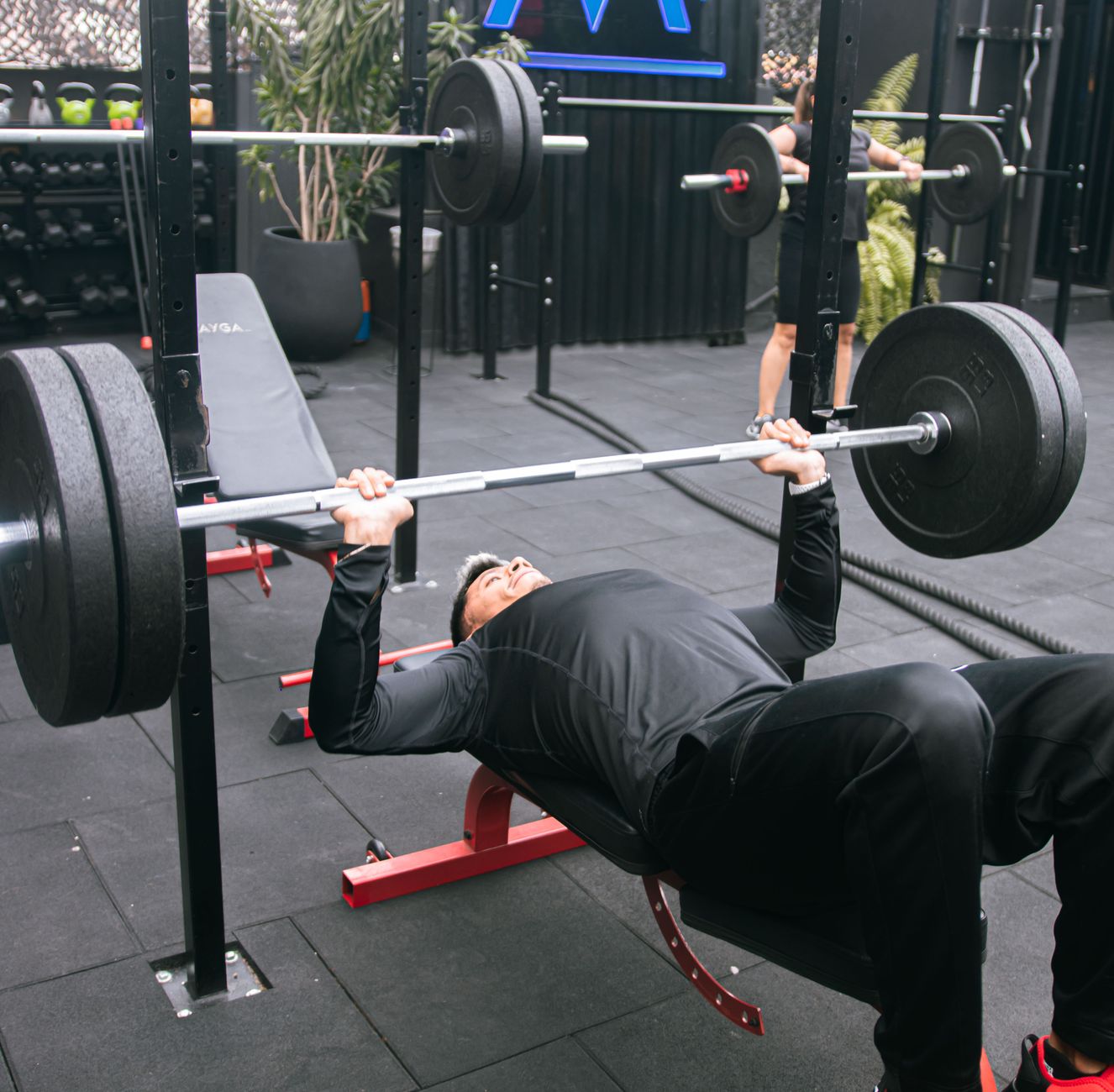
Unrack the bar, hit your 5 reps at an RPE 8-9 (leaving 1-2 reps in reserve), and rack it cleanly. Hit your timer for 3 minutes immediately.
For the first 60 seconds, walk around, breathe through your diaphragm, and take a sip of water. In minute two, chalk your hands and visualize your setup. In the final 30 seconds, lie back on the bench, set your arch, retract your scapulae, and grab the bar. When the timer hits zero, unrack.
Progression Strategies Based on Rest and Load
Progressive overload isn’t limited to adding weight. Managing rest efficiency is a legitimate variable for building muscle.
| WEEK 1: 225 lbs x 8 reps | 3:00 Rest (Baseline) |
|---|---|
| WEEK 2: 225 lbs x 8 reps | 2:30 Rest (Density Progression) |
| WEEK 3: 230 lbs x 8 reps | 3:00 Rest (Load Progression) |
Use these two straightforward progression paths:
1. Load-First Progression (Primary Compounds)
Keep your rest strictly fixed at 3 minutes. Week over week, aim to add 2.5 to 5 pounds while hitting the exact same rep targets. Because your rest period is locked, you know the strength increase is genuine neural and muscular adaptation—not the artificial result of taking an extra two minutes of rest before the final set.
2. Density Progression (Hypertrophy Accessories)
On Tier 3 and Tier 4 accessory movements, you can drive progressive overload by reducing rest intervals. Maintain identical weight and rep execution. If you perform 3 sets of 12 reps on dumbbell lateral raises with 90 seconds of rest in Week 1, and complete the exact same 3x12 with 60 seconds of rest in Week 3, you’ve forced your deltoids to handle the same mechanical work in less time. That represents direct adaptation.
Form Cues & Common Mistakes
Controlling your rest between sets requires avoiding major traps that ruin training intensity:
- The Phone Black Hole: Keep your phone in your gym bag or put it in airplane mode. Staring at social media between sets destroys focus. It extends 2-minute rests into 6-minute rests. It lets your body temperature drop.
- Rushing Out of False Ego: Some lifters cut their rest down to 45 seconds on heavy deadlifts or squats to prove how conditioned they’re. The result is almost always sloppy form, rounded lower backs, reduced loads, and zero additional hypertrophy.
- Ignoring Autoregulation on Bad Days: While timers are essential, don’t step under a 400-pound squat while hyperventilating. If you had a brutal set that spiked your heart rate past its recovery threshold, take an additional 30 seconds to regulate your breathing before grabbing the bar.
- Changing Rest Times Every Session: If you rest 90 seconds on bench press on Monday and 4 minutes on bench press next Friday, you can’t accurately track your strength progression. Inconsistency in rest ruins your training data.
Gear We Use
When moving heavy loads on strict rest intervals, specific gear keeps you locked in without wasting setup time.
- 10mm Leather Lever Belt: For heavy compound squats and deadlifts, a solid 10mm lever weightlifting belt provides the intra-abdominal pressure needed to brace effectively set after set. Lever mechanisms allow you to pop the belt open instantly between sets so you can catch your breath without unclamping prongs.
- Heavy-Duty Wrist Wraps: On heavy bench and overhead presses, a pair of heavy duty wrist wraps keeps the wrist joint neutral, transferring force directly into the bar without joint fatigue cutting your sets short.
Not sure where your max actually sits? Our 1 rep max calculator runs all seven published formulas on the same set and shows you how far apart they land, so you can see how much to trust the number before you program around it.
Frequently Asked Questions
What happens if I rest longer than 5 minutes between sets?
Resting longer than 5 minutes causes your heart rate to normalize completely, cools down joint fluid, and drops your intramuscular temperature. Unless you’re a powerlifter moving maximum loads above 90% 1RM, this extended break lowers training density without providing any extra muscle-building benefit.
Is a 60-second rest period enough for building muscle?
A 60-second rest period is sufficient for single-joint isolation exercises like bicep curls, lateral raises, and calf raises where systemic cardiovascular fatigue is low. However, 60 seconds is too short for heavy compound movements like squats or bench presses, where incomplete ATP recovery will force you to reduce load and mechanical tension.
Will shorter rest periods burn more fat during my workout?
Shorter rest periods increase heart rate and acute caloric expenditure slightly during the workout, but resistance training should be prioritized for mechanical tension and muscle retention. Fat loss should be driven primarily through an energy deficit in your nutrition, not by turning your heavy strength sets into rushed cardio circuits.
How do I know if I’m resting long enough between heavy sets?
You’ve rested long enough when your breathing has returned to a controlled, steady rhythm, your targeted muscles are free of acute burn, and you feel mentally focused to produce maximal force. For most lifters performing heavy compound movements, this physiological state is reached between 2.5 and 4 minutes.
Should rest periods be different when cutting versus bulking?
Your rest periods should remain identical whether you’re cutting or bulking. The stimulus required to retain muscle in a deficit is the exact same stimulus required to build it in a surplus. Shortening rest periods during a cut compromises strength and increases muscle loss risk by artificially capping mechanical tension.
Conclusion
Rest isn’t dead time; it’s a vital training variable. It dictates mechanical tension, volume preservation, and movement quality. When you let rest periods blow past five minutes, you sacrifice workout density, lose mental focus, and allow your core temperature to plummet. Conversely, when you rush your compound lifts to chase a pump, you gut your force output and leave strength on the table.
Stop winging your recovery windows. Set a countdown timer the second you rack the weight on your next workout. Give your heavy primary lifts the full 3 to 4 minutes they demand to move maximum loads. Clamp down on your accessory movements with strict 60-to-90-second limits.
Put your phone away. Track the seconds between sets with the same discipline you use to track the weight on the bar. Watch your gym performance improve immediately.
Related Articles
- How Much Protein Do You Actually Need Per Day to Build Muscle for Serious Lifters 2026
- Bulking vs Cutting for Serious Lifters: How to Do Both Right and When to Switch in 2026
- How to Build a Push Day Workout for Serious Lifters: Exercises, Sets, & Reps (2026)
- HIIT vs Steady State Cardio: Which Burns More Fat and When to Use Each
Where to Buy


💬 Join the Conversation
Have thoughts on this article? We'd love to hear from you.